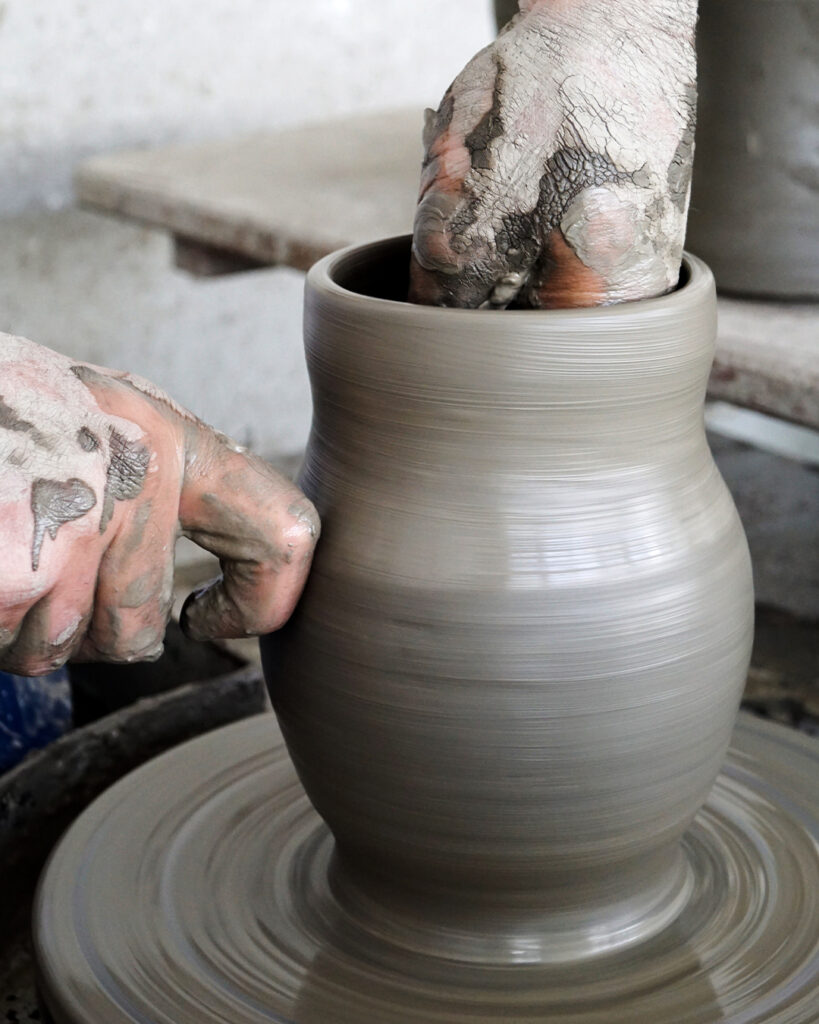
The School of Ceramics teaches the art of know-how Combining knowledge of the oldest knowledge to research and technological innovation.
Recover, produce and train are key notions that guide the School of Ceramics and the Experimental Ceramics Center. Tied closely to these is the concept of innovation. Innovation as a starting and ending point, as a cycle and pathway to arrive at New methods, new systems.
An innovation that involves the world of ceramics and allows the manufacturing sector to continue to exist, to produce by strengthening itself and continuing to excel as a high quality product of Made in Italy.
The School of Ceramics teaches the art of know-how Combining knowledge of the oldest knowledge to research and technological innovation.
Recover, produce and train are key notions that guide the School of Ceramics and the Experimental Ceramics Center. Tied closely to these is the concept of innovation. Innovation as a starting and ending point, as a cycle and pathway to arrive at New methods, new systems.
An innovation that involves the world of ceramics and allows the manufacturing sector to continue to exist, to produce by strengthening itself and continuing to excel as a high quality product of Made in Italy.
Craftsmen, professionals and technical staff with decades of experience
The teachers were carefully chosen and selected on the basis of their knowledge to be the instructors involved in the activities of the School of Ceramics.
Craftsmen, professionals and technical staff with decades of experience
The teachers were carefully chosen and selected on the basis of their knowledge to be the instructors involved in the activities of the School of Ceramics.
During the years numerous courses were developed and implemented, with a focus on experimentation and applied research, on new professional models and languages that have enabled the evolution of tools for educational communication.
A journey into a future that recognizes the importance of classical ceramic workmanship but seeks to develop new and more contemporary content and products.
The goal is to Creating a model of ceramic know-how grafting with other territorial manufacturing sectors, to the point of making countless innovations in both the use of materials and production processes.
During the years numerous courses were developed and implemented, with a focus on experimentation and applied research, on new professional models and languages that have enabled the evolution of tools for educational communication.
A journey into a future that recognizes the importance of classical ceramic workmanship but seeks to develop new and more contemporary content and products.
The goal is to Creating a model of ceramic know-how grafting with other territorial manufacturing sectors, to the point of making countless innovations in both the use of materials and production processes.
The School of Ceramics proposes an exclusive growth process that ensures that companies and individuals develop new sources to enable the world of ceramics not to succumb to time, but to continuously endure and evolve. All this is possible thanks to the deep and direct interaction with the Experimental Ceramics Center.
Knowledge recovery and educational production are historical workshops of School of Ceramics, focusing on three main activities:
Recovery of the Technical Knowledge of Ceramics:
Saves and catalogs knowledge of ceramic craftsmanship within the CCS Oral History Archive (ASOCCS), in which the voices and actions of the School's potters, teachers and professionals are collected.
Production of teaching tools necessary for teaching and dissemination of knowledge:
The codification of knowledge in order to move from an 'unconscious knowledge' of mechanical and repetitive skills and activities to a clear and conscious knowledge of past and contemporary ceramic techniques and technologies.
Training of highly specialized personnel capable of making ceramic companies competitive
It is distinguished by its commitment to creating highly competent professionals who can cope with the ever-changing needs of the ceramic industry.
courses goal
between past and future
The School of Ceramics proposes an exclusive growth process that ensures that companies and individuals develop new sources to enable the world of ceramics not to succumb to time, but to continuously endure and evolve. All this is possible thanks to the deep and direct interaction with the Experimental Ceramics Center.
Knowledge recovery and educational production are historical workshops of School of Ceramics, focusing on three main activities:
Recovery of the Technical Knowledge of Ceramics:
Saves and catalogs knowledge of ceramic craftsmanship within the CCS Oral History Archive (ASOCCS), in which the voices and actions of the School's potters, teachers and professionals are collected.
Production of teaching tools necessary for teaching and dissemination of knowledge:
The codification of knowledge in order to move from an 'unconscious knowledge' of mechanical and repetitive skills and activities to a clear and conscious knowledge of past and contemporary ceramic techniques and technologies.
Training of highly specialized personnel capable of making ceramic companies competitive
It is distinguished by its commitment to creating highly competent professionals who can cope with the ever-changing needs of the ceramic industry.
archive of oral history
past and contemporary ceramic technologies
The recovery activity saves and catalogs the knowledge of ceramic craftsmanship within theCCS Oral History Archives (ASOCCS), in which the voices and actions-in the classroom or laboratory-of the School's ceramists, teachers and professionals are collected.
The activity of educational production codifies knowledge in order to move from 'unconscious knowledge,' made up of mechanical and repetitive skills and activities performed by artisans, to a Clear and conscious knowledge of techniques and past and contemporary ceramic technologies.
Finally, the training activity stands out for its commitment to creating highly competent professionals and able to meet the ever-changing needs of the ceramics industry. Through an integrated, multidisciplinary approach, the School of Ceramics offers courses that combine in-depth theoretical knowledge with intensive hands-on practice.
The recovery activity saves and catalogs the knowledge of ceramic craftsmanship within theCCS Oral History Archives (ASOCCS), in which the voices and actions-in the classroom or laboratory-of the School's ceramists, teachers and professionals are collected.
The activity of educational production codifies knowledge in order to move from 'unconscious knowledge,' made up of mechanical and repetitive skills and activities performed by artisans, to a Clear and conscious knowledge of techniques and past and contemporary ceramic technologies.
Finally, the training activity stands out for its commitment to creating highly competent professionals and able to meet the ever-changing needs of the ceramics industry. Through an integrated, multidisciplinary approach, the School of Ceramics offers courses that combine in-depth theoretical knowledge with intensive hands-on practice.

 English